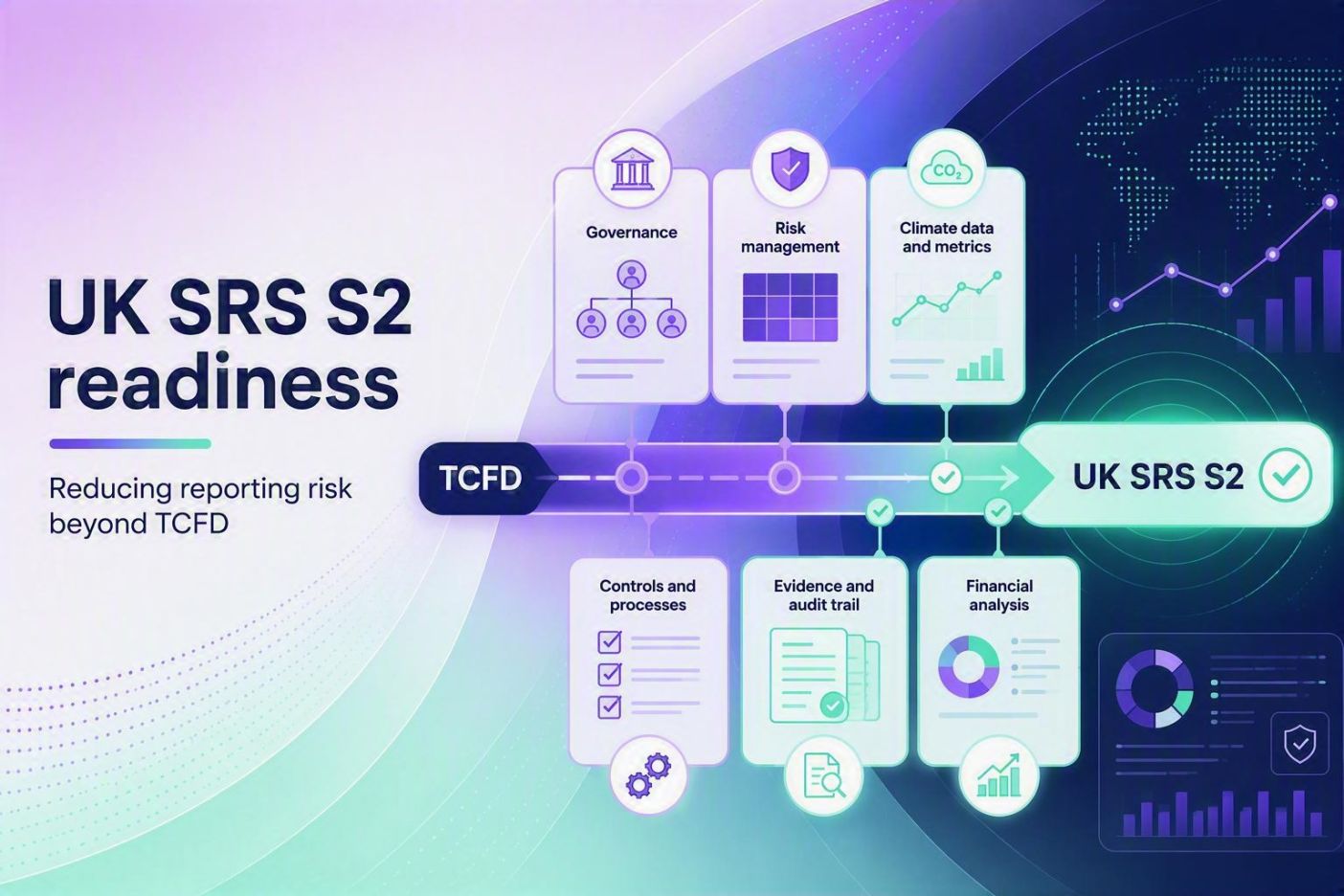

UK SRS S2 is not just a reporting update. Early readiness assessments help organisations identify gaps, prioritise action and reduce reporting risk.
Stay informed with regulations, insights & events by joining our mailer
For companies already reporting against TCFD, UK SRS S2 may look familiar.
That familiarity creates a risk: organisations can assume they are ready because the disclosure headings are recognisable, while gaps remain in the evidence, controls, financial analysis and data that sit underneath. A focused readiness assessment helps sustainability leaders find those gaps early, prioritise action and reduce the risk of discovering weaknesses late in the reporting process.
Below, we highlight the key uplifts from TCFD to UK SRS S2 and explain how to approach preparation through a practical, risk-based lens.
Governance
The overall expectation remains familiar, but S2 asks for more detail on the governance processes, controls and procedures used to oversee climate-related risks and opportunities. This includes how responsibilities are reflected in terms of reference, mandates, role descriptions and relevant policies.
Companies need to demonstrate how climate oversight and responsibility operate in practice, what governance controls support them, and where accountability sits. The main risk is that formal governance language is not backed by clear mandates, decision rights or evidence of oversight.
Check that your reporting reflects how your governance arrangements work in practice. For example, ensure there is alignment with committee terms of reference, role descriptions and relevant policies. Where climate and wider sustainability matters are overseen through the same structures, consider whether an integrated governance disclosure would provide a clearer picture and avoid unnecessary duplication.
Strategy
S2 goes further in explaining how climate-related risks and opportunities affect the business. Companies are expected to explain where these materialise across their business model and value chain, how they are responding, and what the current and anticipated financial effects could be. S2 also encourages organisations to consider industry-specific climate-related risks and opportunities and introduces more detailed expectations around transition plans, strategic resilience and the assessment of future impacts.
Climate reporting needs to connect more clearly to strategic and financial decision-making, showing how climate-related risks and opportunities could affect different parts of the business and its financial position. The main risk is that the narrative describes climate issues, but does not show how they influence planning, capital allocation or financial resilience.
Review your existing climate risk and opportunity assessment and identify the pathways through which each material issue could affect the business. Consider where effects could arise across the business model and value chain, and how they could influence financial position, financial performance or cash flows over the short, medium and long term.
Risk management
S2 requires more transparency on how climate-related risks and opportunities are identified, assessed, prioritised and monitored, including the data sources, assumptions and scenario analysis that inform those processes. It also places greater emphasis on how these processes connect with wider risk management frameworks.
Companies will need stronger evidence of the processes behind their disclosures, rather than simply describing the outcome. The main risk is that risk management claims cannot be traced back to documented inputs, assumptions, thresholds or governance review.
Document the processes used to identify, assess, prioritise and monitor climate-related risks and opportunities. Capture the key inputs and parameters, including relevant data sources, operational scope and the role of scenario analysis, and explain how these processes connect with the organisation’s wider risk management framework.
Metrics and targets
The most significant uplift may be felt in the specificity and traceability of climate-related data. UK SRS S2 requires information across the cross-industry metric categories, relevant industry-based metrics, and more detailed GHG emissions disclosures covering Scope 1, 2 and 3. This includes greater transparency over measurement approaches, inputs and assumptions, the categories included in Scope 3, and the treatment of Scope 2 emissions.
Targets are also subject to more detailed disclosure, including how they were set and reviewed, how progress is monitored and, for net GHG emissions targets, the extent to which achievement depends on the planned use of carbon credits.
Companies need confidence in the methodologies, assumptions and governance underpinning their climate metrics and targets, as well as a clear audit trail from source data to disclosure. The main risk is that data, ownership or methodology weaknesses only become visible when disclosures are being finalised or assured.
Trace key climate metrics back to their source. Check who owns the data, how it is calculated and what assumptions underpin it. This will help identify gaps in data, methodology or ownership before S2 reporting becomes a requirement.
How a UK SRS S2 readiness assessment reduces risk
The familiar structure should not disguise the scale of the uplift. For many TCFD reporters, the most important next step is not rewriting the disclosure. It is testing whether the governance, risk processes, financial analysis and data behind it are sufficiently robust for UK SRS S2.
A focused readiness assessment can help sustainability leaders compare current reporting and underlying processes with S2 expectations, identify missing evidence or unclear ownership, and distinguish urgent reporting gaps from longer-term improvements. This reduces risk by turning a broad regulatory uplift into a practical sequence of actions across sustainability, finance, risk, governance and data teams.
Understand where your biggest S2 risks sit
At Ever Sustainable, we help organisations assess their readiness for UK SRS S2, identify where existing TCFD reporting provides a strong foundation, and prioritise the evidence, controls and data improvements needed for a more controlled route to reporting.